
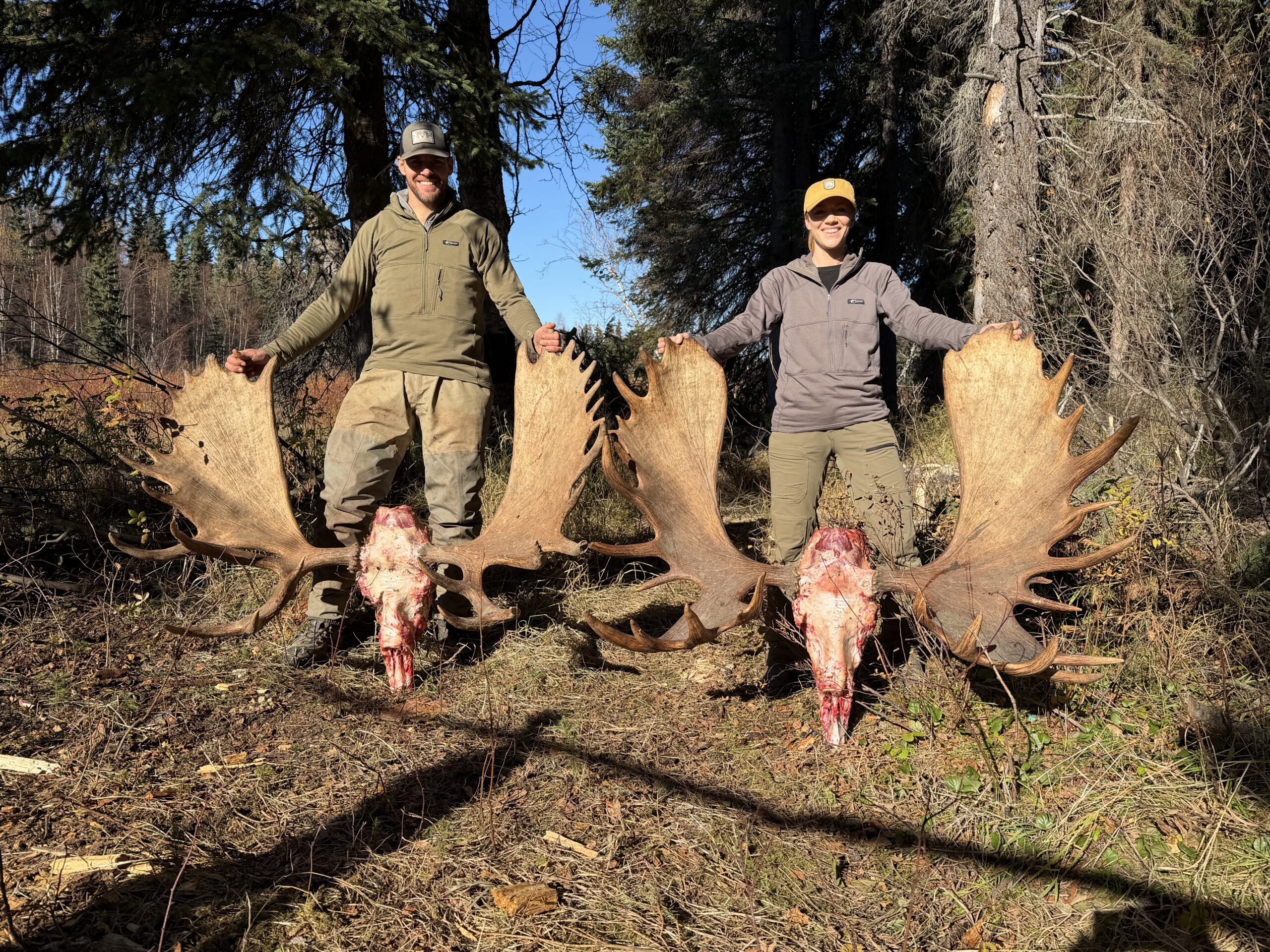
Some Alaska hunts are years in the making, and our 2026 moose hunt was one I’d been looking forward to since the previous season.
In 2025, my hunting partner Steve and I had ventured into a remote part of Alaska to see if we could put together a successful moose hunt. Steve had nearly 20 years of experience hunting the area before taking a few years away, but for me, it was an opportunity to learn the country and figure out the logistics of hunting somewhere so remote.
That first year went incredibly well.
We had success, built relationships within the local community, and learned a tremendous amount about the boat, fuel requirements, transportation, and what it would take to make the hunt repeatable.
More importantly, we came away confident that we could return and have another enjoyable, successful hunt.
That confidence was a big reason I was excited about 2026.
This time, we were bringing my wife, Lynsie.
I love hunting and the adventures that come with it, but one of the hardest parts of these trips is leaving Lynsie behind. There’s always a little guilt and sadness that comes with being away, especially when I’m experiencing things I know she would enjoy.
Usually, I come home with pictures and stories, trying to explain what it was like to travel through remote Alaska, see the wildlife, meet people in small communities, and experience a way of life that is so different from what most people are accustomed to.
This year, she would get to experience all of that firsthand.
And now that Steve and I had a successful season under our belts, we felt much more comfortable bringing her along.
Our goal was to harvest two bulls: one to provide meat for Steve and his family, and another for Lynsie and me.
I was especially hopeful that Lynsie would get an opportunity at a good bull of her own.
We had no idea just how well things were about to work out.
Preparing for Another Remote Alaska Moose Hunt
Even with the experience we’d gained the previous year, a hunt like this requires an enormous amount of preparation.
We needed to coordinate flights, purchase enough fuel for the entire hunt, arrange transportation for ourselves and the meat afterward, and make sure all our equipment and supplies were waiting for us when we arrived.
Most of our gear had to be shipped ahead of time. There simply wasn’t a practical way to bring everything with us on the passenger flight.
And once we were there, getting additional supplies wasn’t really an option.
Our inflatable jet boat was a major part of making the hunt possible.
Shipping an inflatable and motor was much easier and more economical than transporting a traditional hard-bottom boat or trying to purchase something reliable locally.
It also gave us a convenient storage solution. At the end of the hunt, we could deflate the boat and store it with the motor inside a shipping container until the following season.
The biggest uncertainty was always the weather.
We could spend months planning every detail, but we couldn’t control whether the flights would operate when we needed them.
Once we finally arrived and had our equipment, fuel, and boat ready, it was an incredible feeling of relief.
The planning was behind us.
It was time to hunt.
How We Hunt Moose Along the River
Our approach to this hunt involves a combination of traveling the river and calling moose from an established camp.
Both methods have their advantages, and we like having the flexibility to switch between them depending on what we’re seeing.
Traveling the river allows us to cover a considerable amount of country and look for moose moving along the banks or through openings in the vegetation.
There’s something exciting about rounding a bend knowing that a bull could be standing just around the corner.
But river hunting can also test your patience.
You can spend hours traveling through the same stretches of country, staring into thick willows and hoping to catch a moose during the brief moment it happens to step into view.
It’s a bit of a love-hate relationship.
The anticipation is always there, but so is the possibility of spending an entire trip looking at nothing but trees and riverbanks.
That’s why we also spend a considerable amount of time hunting from camp.
Rather than relying entirely on spotting a bull from the boat, we can settle into promising habitat, make cow calls, imitate bull grunts and raking, and listen for animals moving through the surrounding country.
Sometimes a bull responds quickly. Other times, you can spend hours calling without anything showing itself.
We don’t treat either strategy as the only way to hunt. Having both options gives us flexibility, which is especially valuable when conditions aren’t what we expected.
And this year, conditions were definitely different.
The river was exceptionally high, and we suspected the water had pushed some bulls farther back into the thick cover.
We’d also heard from people in the local community that they weren’t seeing as many bulls along the river as they normally would.
That made us even more interested in spending time calling from camp rather than relying exclusively on river encounters.
Still, our first trip upriver gave us plenty of encouragement.
While transporting fuel toward camp, we spotted five cows and two bulls.
One bull was smaller than what we were hoping to find for Lynsie, and the other never presented a shooting opportunity.
We decided to pass on the smaller bull.
It was our first day, we were in the middle of moving fuel, and the shooting situation would have been rushed. We had plenty of time ahead of us, and I didn’t want to force an opportunity that could turn into a complicated recovery, particularly for Lynsie’s first moose.
The encounter was encouraging regardless.
We were seeing moose, they were moving, and there were signs that rut activity was underway.
After months of preparation, those were exactly the things we wanted to see.
We were finally in hunting country, and everything was starting to come together.
Settling Into Camp
Our campsite was a spot we’d used before, so it already had some basic improvements.
There were flattened areas for tents, an established fire ring, a cooking bench, some cooking equipment, and even firewood we’d left behind the previous year.
We got our tents up fairly quickly. Lynsie and I stayed in our Argali four-person tipi, while we worked together to organize the kitchen, cut and move firewood, and get camp established.
That first evening was exactly what I’d hoped for.
We did some calling, relaxed around the fire, and enjoyed being back in the Alaska wilderness.
There is something satisfying about finally getting camp established after spending so much time planning and traveling. Once the tents are up, the fire is going, and the equipment is organized, life becomes pretty simple.
You hunt, eat, cut firewood, and enjoy where you are.
The following morning, things got interesting.
A Bull That Wouldn’t Commit
We were around camp when we heard sticks breaking in the brush.
A bull was working his way toward us.
Steve began calling, using cow calls, bull grunts, and raking to imitate another moose.
Before long, we could hear the bull raking brush nearby.
He eventually worked to within roughly 150 yards of camp, but the vegetation was so thick that getting a clear look at him was difficult.
At one point, we caught a brief glimpse of him crossing an opening in the willows.
It was a good bull.
Unfortunately, the opening was too brief to provide a shooting opportunity.
What made the encounter especially interesting was that several real cow moose were also calling nearby.
This was the first time I’d ever heard actual cow moose calling in the wild, and it was fascinating.
We suspected the bull was more interested in the real cows than in investigating our calls or responding to what might have sounded like another bull challenging him.
He never committed enough to give us a shot.
Even so, the encounter was valuable.
We knew there was a good bull close to camp, and we’d seen firsthand that moose were responding to calling.
It also gave Lynsie some excellent practice.
We worked through different rifle positions, finding steadier rests, and figuring out how to get her set up quickly when an animal appeared.
Those are things you can practice at home, but doing them while a bull is actually moving through the brush nearby is a different experience.
We didn’t harvest that bull, but the morning left us encouraged.
We had no idea how useful that experience would become just a few hours later.
“I’m Going to Go Call One In for You”
After the morning encounter, everything seemed to shut down.
We spent most of the day around camp, drinking coffee, eating, snacking, and handling chores.
Eventually, I started splitting the pile of firewood we’d cut and moved. There was plenty of it, but it felt good to have something productive to do.
Around 4:30 that afternoon, I decided I was going to try calling.
I’d never really done much moose calling myself. Steve had so much more experience that I’d always been content to let him handle it.
But I figured there was no reason not to give it a shot.
As I headed toward a small clearing near where we’d parked the boat, I jokingly told Lynsie:
“I’m going to go call one in for you.”
I spent about three to five minutes making cow calls, bull grunts, and raking brush.
Then I walked back toward camp.
As I passed Lynsie and Steve, I made a comment about how sexy my calling sounded.
Naturally, I was pretty pleased with myself.
Then I went to pee.
While I was occupied, Lynsie and Steve heard a stick break.
They immediately headed toward the clearing, with Lynsie grabbing her SIG Cross.
I finished what I was doing, grabbed my rangefinder and Steve’s rifle, and started walking toward them.
I wasn’t in much of a hurry.
In my experience, when bulls respond to calling, they often work their way in slowly—if they come at all.
I figured we had time.
I was wrong.
As I approached the clearing, I saw Lynsie standing with her rifle shouldered.
I couldn’t see exactly what she was aiming at because the brush was obstructing my view, but I assumed there was a bull.
Then I heard Steve say:
“If you have a shot, take it.”
And Lynsie fired.
Offhand!
Steve immediately said she’d hit him.
I hurried down to her and finally got a look at the bull.
He was lying on the opposite bank, approximately 140 yards away. His head was still up, so I helped Lynsie get settled onto a steadier rest in case she needed to shoot again.
The bull stood, and Lynsie put two more shots into him.
She handled the entire encounter incredibly well.
Later, while butchering, we confirmed that all three shots had struck vital areas, including one through the heart.
Moose are enormous animals, and even well-placed shots don’t always result in an immediate collapse. We believe in staying prepared to make necessary follow-up shots until the animal is down.
After the third shot, the bull jumped into the river and died.
We were ecstatic.
But there wasn’t much time to celebrate.
The bull had started floating downstream.
Recovering Lynsie’s First Bull
We immediately jumped into the boat and headed toward the floating bull.
Once we maneuvered alongside him, I managed to get a rope around one of his antlers.
We hauled him toward a sandbar and pulled him as far out of the water as we could.
Only then did we finally have a chance to process what had happened.
Lynsie had harvested her first bull moose.
And somehow, on my first real attempt at calling, I’d called him in for her.
He was a tremendous animal, with particularly unique palmated fronts that gave his antlers a lot of character.
We took our time admiring him, taking pictures, and appreciating just how incredible the whole encounter had been.
It was hard to believe how perfectly things had worked out.
One of my favorite parts of the story came afterward, when Lynsie told me what the bull had done while I was making my leisurely way back toward the clearing.
According to her, he came in mad.
He was grunting throughout his approach, and she thought he had responded especially strongly to the raking.
While I was assuming we had plenty of time, she and Steve were watching an aggressive bull close the distance.
The contrast still makes me laugh.
Earlier that morning, we’d spent a long time trying to convince a bull to commit without success.
That afternoon, a few minutes of calling had brought another one in so quickly that I almost missed the whole thing.
Two Hours on a Sandbar
Once we’d celebrated, it was time to get to work.
Butchering a moose on a sandbar with part of the animal still in shallow water might sound miserable, but it honestly wasn’t too bad.
We had enough of the bull exposed to work effectively.
There were occasional careless moments when someone would step too deep and get water in a boot, or squat down and soak their pants.
We also had to be careful about sand getting on the meat.
We used a tarp to help keep everything clean and off the ground, and although we picked up a little sand here and there, it was minimal.
Steve and I started skinning while Lynsie pulled on the hide and helped wherever she could.
Steve worked on the front leg while I handled the back.
Lynsie was constantly involved—pulling hide, holding legs, moving meat, and helping with the skinning.
Steve removed meat from the neck while I worked on the backstraps, tenderloins, and ribs.
Once we’d finished the exposed side, we flipped the bull and repeated the process.
We worked extremely well together.
I don’t think there was a point when Lynsie wasn’t actively helping with something.
In just over two hours, we had the bull skinned, the meat removed, and the head detached.
It was a tremendous feeling.
We had our first bull down, the meat was taken care of for the evening, and the three of us had worked together to get it done.
Back at camp, we settled around the fire and replayed the encounter over and over.
Everyone had experienced different parts of it.
Lynsie and Steve had seen the bull approaching while I was still making my way toward them. I’d watched Lynsie take her first shot, then helped her prepare for the follow-ups.
Hearing everyone’s version of the story was almost as entertaining as the encounter itself.
We were still riding that high when we finally settled in for the night.
A Quiet Day Before Everything Changed Again
The next day was slower.
We heard some bulls in the surrounding country, but nothing came into view.
We spent a little time traveling the river and returned to Lynsie’s bull to finish caring for the meat.
We cut willows to get the meat elevated off the ground and improve airflow for cooling. We also brought her bull’s head back to camp, where I spent time skinning it.
The rest of the day was filled with ordinary camp chores, relaxing by the fire, and enjoying being outside.
It was a welcome change of pace after the excitement of the previous evening.
The following morning, we loaded Lynsie’s moose meat into the boat and started heading downriver.
The boat was heavy.
Too heavy to get on step.
We were making slow progress when Lynsie suddenly said one word.
“Bull!”
My Turn: A 60-Inch Surprise
I looked up and saw a bull standing along the river.
We were only about 50 yards away.
At that point, we weren’t worried about finding another trophy-sized moose.
Lynsie had already harvested an exceptional bull, and our goal was to fill the second household’s freezer with another legal animal.
I saw antlers and immediately focused on getting ready.
I grabbed my rifle, removed the scope cover, and chambered a round.
Steve shut off the motor.
I got the bull in my scope.
The only opportunity I had was a frontal shot.
I’d never taken a frontal shot on an animal before, but I felt confident about the placement and knew I probably didn’t have much time before he disappeared into the willows.
I told Steve:
“I’m going to shoot him in the chest.”
“Yup,” he replied.
I squeezed the trigger.
The bull took a few steps backward into the willows and went down.
It all happened incredibly fast.
One moment, we were slowly plowing downriver with a boat full of meat.
The next, we had another bull down.
We were all a little stunned.
Steve restarted the motor and brought us to shore.
I still had no idea how big the bull was.
Steve thought he might be similar to a smaller bull we’d harvested the previous year, which had measured around 40 inches.
That sounded perfectly fine to me.
I tied up the boat and walked toward the animal.
As soon as I got close, I realized he was much bigger than I’d expected.
When Steve and Lynsie joined me, they had the same reaction.
This was a big bull.
We took pictures and pulled out a tape measure.
Sixty inches wide.
I couldn’t believe it.
Lynsie had harvested an incredible bull that we’d measured at approximately 56 inches, with unique fronts and tremendous character.
Now I was standing beside a 60-inch bull of my own.
We had come into the hunt hoping to harvest two bulls to provide meat for our families.
We never could have dreamed up a scenario where Lynsie and I would both harvest animals like these on the same trip.
And what made it even more special was how it happened.
I’d called her bull in.
She’d spotted mine.
We had each played a direct role in the other’s success.
After another round of photographs and celebrating, we started butchering.
We followed essentially the same process we’d used on Lynsie’s bull and, once again, finished the initial breakdown in a little over two hours.
By then, we’d become a pretty efficient team.
But with the second bull broken down, we had a problem.
The Work After Two Bulls
We had an enormous amount of moose meat to move.
The boat had already struggled to get on step with Lynsie’s bull.
Now we were looking at two bulls’ worth of meat, three people, fuel, and essential equipment.
We left Lynsie’s bull’s head and two hindquarters behind temporarily, hoping that removing some weight would help.
Even then, our rough estimates suggested we were a couple hundred pounds over the boat’s approximately 1,200-pound rated capacity.
In the slow-moving, deeper water, we simply couldn’t get on step.
We plowed along for about an hour before stopping for fuel.
Not long afterward, we reached shallower, faster-moving water, and the boat finally managed to plane.
We were thrilled.
The difference was enormous, effectively cutting the remaining travel time in half.
It was one of those small victories that feels particularly good when you’re in the middle of a remote adventure.
We eventually made it back to our staging point, got Lynsie’s meat hung, and spent the night in a cabin with a roof over our heads.
The following morning, we headed back upriver to retrieve the remaining equipment and meat.
We picked up my bull’s head and continued to camp, where we started a fire to warm up.
I worked on skinning my bull’s head while Lynsie and Steve broke down the tents, packed our equipment, and organized everything for the trip back.
At one point, we had both bulls’ heads riding together on the front of the boat.
That was a pretty incredible sight.
Two beautiful Alaska bulls, harvested by husband and wife during the same hunt.
It was also a little bittersweet leaving camp.
We’d spent so much time planning and looking forward to this trip, and now it was already coming to an end.
I knew it would probably be another year before we returned.
During our travels that day, we noticed that the spine from Lynsie’s bull had been dragged away from where we’d left it.
We suspected a bear had found the remains.
That was a little unsettling because some of my bull’s meat was still waiting to be retrieved.
We continued our work, collected additional meat, and made another trip back.
That evening, we settled into the cabin again and even managed to watch some Thursday Night Football.
It was a welcome bit of normal life after several days of campfires, butchering, and river travel.
One Final Trip for the Meat
The next morning, we got up, drank coffee, and helped Lynsie get packed for her flight home.
She wanted to stay for the rest of the trip, and I was disappointed to see her leave.
But with the amount of moose meat we needed to transport, having her fly out ahead of us made the most sense logistically.
Fog delayed her flight a little, which pushed back the start of our final river trip.
Steve and I still needed to retrieve the remaining meat, and we knew we’d have a heavy load on the return.
Once Lynsie was on her way, we headed upriver.
We made good time getting back to my bull.
I tied up the boat and immediately noticed that something wasn’t right.
The tarp covering the meat had been moved.
The ribs were out of place.
Some loose meat had been disturbed.
And the spine had been covered with grass, dirt, and sticks.
I immediately told Steve we needed to be careful.
A bear had clearly been working around the remains.
We couldn’t tell what kind of bear it was. There weren’t any good tracks, and we never saw the animal.
But because relatively little meat had been disturbed, we wondered whether it had only recently discovered the site.
While Steve refueled the boat, I grabbed my rifle and kept watch, knowing a bear could still be nearby.
Once he finished refueling, we both got to work loading the remaining meat into the boat.
Fortunately, we never encountered the bear.
Even better, we hadn’t lost any of the meat we intended to recover.
We felt we’d done what we reasonably could to protect and cool it while continuing the hunt, but there’s always an element of uncertainty when leaving meat in remote country.
With everything loaded, we were finally ready for the last river trip.
Eight Miles an Hour
We were relieved to leave without a bear encounter.
We also knew the boat was going to be heavy.
Once we got moving, we were traveling at about eight miles an hour.
I did some quick math and realized that maintaining that pace would put us back around dark.
Neither of us was excited about navigating the river after sunset.
But despite the slow going, we were actually in pretty good spirits.
We had all the meat.
We’d finished our final retrieval.
And this was the last major piece of the adventure before heading home.
Since we were moving so slowly, I decided to make use of the time.
I started cutting the lower legs off the four moose quarters.
I don’t think I’ve ever done more delicate knife work than trying to remove lower legs while sitting in an inflatable boat.
I was extremely conscious of where that knife was at all times.
Eventually, we reached another stretch of shallower, faster-moving water.
The boat finally got on step.
We were overjoyed.
Suddenly, we weren’t looking at arriving in the dark anymore. We could make good time and enjoy the rest of the trip without worrying about running out of daylight.
To cap things off, we spotted another large bull during the ride back.
It was a fitting final wildlife encounter.
We’d harvested two incredible bulls, and there were still good animals in the country.
It certainly gave us something to look forward to the following year.
Bringing the Hunt Home
Once the river work was finished, we turned our attention to cleaning and packing.
We thoroughly scrubbed the inflatable boat, deflated it, and stored it with the motor inside the shipping container.
That was one of the advantages we’d hoped for when choosing this setup. Instead of leaving a boat exposed to the elements, we could put everything away and know it would be protected until our next trip.
We staged the moose meat on pallets in preparation for the charter flight home.
Fortunately, coordinating the flight wasn’t difficult at that point.
We’d arranged it more than six months in advance, and that preparation paid off.
But getting the meat onto the plane wasn’t the moment I finally relaxed.
We still had to get home, unload everything, and get the meat properly hung.
Until that was done, the job wasn’t finished.
It wasn’t until we were back in Anchorage with the meat hung and taken care of that I finally felt the weight of the trip lift off my shoulders.
We had done it.
Two bulls harvested, recovered, transported, and safely home.
Afterward, Lynsie and I went to Lucky Wishbone for burgers and a big salad.
As much as I enjoyed the burger, what I’d really been craving was fresh vegetables.
After spending so long in the field without access to them, a big salad sounded about as good as anything.
It was a simple way to celebrate, but it was exactly what I wanted.
What Made This Hunt Special
People sometimes ask me how different Alaska hunting experiences compare or which one has been my favorite.
I honestly can’t rank them.
Every hunt is different, and I love the experiences for different reasons. Some are physically demanding, some test your patience, and others come together in ways you never could have predicted.
I’m usually already looking forward to the next adventure before the current one is completely finished.
This moose hunt certainly reinforced a few things.
For one, it gave me a lot more confidence in my ability to call moose.
I’d always relied heavily on Steve’s experience, and for good reason. But being able to call in a bull for Lynsie on my first real attempt was something I’ll never forget.
It makes me excited to keep learning and improving.
The trip also reinforced how important planning and flexibility are when hunting in remote Alaska.
We spent months coordinating flights, fuel, equipment, and transportation. Most of that preparation worked exactly as intended.
But there were still things we couldn’t control.
High water, weather delays, changing river conditions, and the logistics of moving two enormous animals all required us to adjust.
You can have an excellent plan and still need to change it.
That’s simply part of hunting in remote country.
And despite those challenges, there honestly isn’t much I’d change about how we approached the trip next year.
We learned more about the boat, gained experience, and came away better prepared for the future.
But when I think back on this hunt, those aren’t the memories that stand out the most.
I can still picture Lynsie standing there with her rifle shouldered, taking that first shot at her bull.
I can still see my own bull facing me through the scope, just before I squeezed the trigger.
Those images are going to stay with me for a long time.
And while the antlers were incredible, the size of the bulls isn’t what made the hunt so meaningful.
We came home with a tremendous amount of wild meat for our families.
We shared an unforgettable adventure with a good friend.
And, most importantly to me, I got to experience it with Lynsie.
Normally, when I come home from an Alaska hunting trip, I’m trying to explain what happened, show her pictures, and describe moments that are difficult to put into words.
This time, she was there.
She heard the bulls calling, felt the excitement when an animal appeared, helped with the butchering, and experienced the long boat rides, campfires, and all the little moments that make these adventures special.
I got to call a bull in for her.
She spotted the bull I harvested.
We each got to be part of the other’s success.
I couldn’t have asked for much more than that.
And as much as I loved this hunt, I know I’ll be just as excited when it’s time to pack up and head into the Alaska wilderness again.
There’s always another adventure to look forward to.
Leave a Reply